The Best Fluffy Pancakes recipe you will fall in love with. Full of tips and tricks to help you make the best pancakes.
These aren’t dainty little rounds. We’re talking palm-sized, half-inch-thick, heaving-with-mix-ins cookies that make bakery display cases look modest. One bite and you’ll understand exactly why Texas claimed them.
Most cowboy cookie recipes fail you. They promise chewy, loaded, bakery-worthy results — and deliver thin, crispy discs that taste like trail mix pressed into a cookie cutter. After 14 years of professional pastry work — from hotel kitchens in Mumbai to artisan bakeries in London — I’ve reverse-engineered exactly where home bakers go wrong.
By the end of this article, you’ll know how to build dough with structural integrity, how to read doneness without cutting cookies open, and how to replicate that fat, bakery-style chew at home.
One more thing before we begin: there’s a secret I’m saving for the end. It has nothing to do with what you add to the dough — it’s about what you do after it comes out of the oven. Most bakers skip it entirely. Don’t skip the outro.
Table of Contents
| Time | 20 min prep |
| Chill Time | 30 min |
| Bake Time | 13 min |
| Yield | 14–16 large cookies (4-inch diameter) |
| Texture Rating: | Crisp edge · Dense chew · Soft centre |
The Ingredients — Building for Structure, Not Just Flavour
The ingredient list is where most recipes quietly set you up to fail. They give you amounts. They don’t give you reasons. Here’s why every choice below is non-negotiable.
The Full List:
| Ingredient | Amount | State / Note |
|---|---|---|
| All-purpose flour | 2 cups (240g) | Spooned & levelled |
| Rolled oats (old-fashioned) | 1½ cups (135g) | Not instant — structure matters |
| Unsalted butter | 1 cup / 2 sticks (226g) | Room temperature, not melted |
| Brown sugar (dark) | 1 cup (200g) | Packed — dark for molasses depth |
| White granulated sugar | ½ cup (100g) | For spread control |
| Eggs | 2 large | Room temperature |
| Egg yolk | 1 extra | Fat = chew; this yolk is load-bearing |
| Pure vanilla extract | 2 tsp | Real vanilla only |
| Baking soda | 1 tsp | |
| Baking powder | ½ tsp | Lift without over-spread |
| Fine sea salt | 1 tsp | Flavour amplifier |
| Cinnamon | 1 tsp | Warmth without overpowering |
| Semi-sweet chocolate chips | 1 cup (170g) | |
| Chopped pecans | ¾ cup (85g) | Toasted — this step is not optional |
| Sweetened shredded coconut | ½ cup (43g) | Chew texture, not just flavour |
On butter state: Room-temperature means your finger leaves an indent without the butter collapsing. Too cold = poor creaming. Melted = flat, greasy cookies. This is the most common silent sabotage in home baking.
The Dough : Why Yours Has Been Falling Flat
Here’s something most recipes don’t tell you: cookie dough is not about mixing — it’s about building layers of air and fat. Undermix and you lose lift. Overmix and you activate too much gluten, turning chew into tough.
Step 1 : Toast Your Pecans First (10 min, 325°F / 163°C)
Spread pecans on a dry baking sheet. Toast until fragrant and one shade darker. This step takes 10 minutes and adds approximately 40% more flavour complexity. Let them cool before adding to dough or they’ll melt your chocolate chips prematurely.
Image prompt: Pecans spread on a parchment-lined baking sheet, lightly golden, steam rising slightly
Step 2 : Cream the Butter and Sugar (4–5 minutes)
Beat room-temperature butter with both sugars on medium-high speed for a full 4 to 5 minutes — not 2, not 3. You’re looking for a mixture that has gone from yellow and dense to pale, almost ivory, and noticeably fluffy. Run your finger across it; it should feel silky, not grainy.
This is your second-best tip: most home bakers under-cream. The air you incorporate here is your leavening insurance policy.
Image prompt: Stand mixer bowl showing pale, fluffy creamed butter and sugar, light and voluminous
Step 3 : Add Eggs One at a Time
Add the 2 whole eggs and 1 extra yolk one at a time, beating for 30 seconds after each. Add vanilla with the last egg. The batter should look glossy and emulsified — almost like a smooth custard base. If it looks curdled and broken, your eggs were too cold.
Step 4 : Combine Dry Ingredients and Fold
Whisk together flour, oats, baking soda, baking powder, salt, and cinnamon in a separate bowl. Add the dry mix to the butter base in two additions on low speed. Stop the moment no dry flour is visible — do not beat. Fold in chocolate chips, toasted pecans, and coconut by hand with a rubber spatula.
The dough should feel substantial. Dense, slightly tacky, and thick enough to hold a peak when you press your spatula into it. If it’s loose or sticky, your butter was too warm.
Image prompt: Rubber spatula folding chocolate chips and pecans into thick, golden cookie dough
OTHER RECIPES :
- Best M&M Cookie Recipe (Thick, Gooey & Easy to Make)
- Easy Thumbprint Cookie Recipe – Perfectly Buttery Every Time
- Best Jello Poke Cake Recipe 2026: Super Moist & Perfect for Any Occasion
The Chill : Why Do Cookies Spread Too Thin?
This is the most asked question in cookie baking — and the answer is almost always the same. Under-chilled dough. When fat is warm, it melts before the egg proteins and starches can set the structure, and the cookie pancakes outward. Cold fat melts slowly, giving the dough time to rise before it spreads.
Chill your dough for a minimum of 30 minutes. For thicker, taller cookies, refrigerate overnight. The flavour deepens noticeably after a long rest — the oats hydrate fully and the molasses in the brown sugar has time to settle into every corner of the fat.
Portion using a large cookie scoop or a ¼-cup measure. Place balls on a parchment-lined sheet, spaced 3 inches apart — these are Texas-sized, and they will spread.
Image prompt: Large dough balls portioned on a baking sheet, perfectly spaced, ready for the oven
The Bake : Reading Doneness Like a Professional
Oven temp: 350°F / 175°C, conventional (not fan-forced)
Time: 12–14 minutes
Position: Centre rack, one sheet at a time
Why do my cookies come out overbaked even at the right time?
Because oven thermostats lie. Budget and mid-range ovens can run 15–25°F hotter than displayed. An oven thermometer costs less than a bag of pecans and will change your baking permanently.
What to look for at 12 minutes: The edges are set and lightly golden. The centres look underdone — pale, slightly puffed, maybe even glossy. That’s correct. Pull them.
The centres will continue cooking on the hot pan for 5 minutes after you pull them from the oven. If the centre looks done in the oven, the cookie will be dry in your hand.
Image prompt: Golden-edged cowboy cookies on a baking sheet, centres still slightly puffed, just out of the oven
Why These Are Bakery-Style — The Climax
Professional bakery cookies have three structural advantages over most home recipes:
1. Toasted fat complexity. Toasted pecans and brown sugar’s molasses create the same deep, almost caramel-adjacent flavour that Maillard reactions produce in a hot commercial oven.
2. Higher fat-to-flour ratio. The extra yolk tips the fat balance just enough to create that characteristic dense, fudgy pull-apart chew that separates a bakery cookie from a packaged one.
3. Generous salt. A full teaspoon of salt sounds like a lot. It isn’t. Salt suppresses bitterness from the chocolate, amplifies the vanilla, and creates the contrast that makes every element taste more like itself.
The Grand Pay-off — The Secret I Promised You
You baked them. You pulled them early. Now here it is:
Immediately after the tray comes out of the oven, use the back of a large spoon to gently press the centre of each cookie flat.
That puffed dome? Flatten it. Not aggressively — just a single firm press. This technique, called the “bakery press,” does two things: it creates those layered, wrinkled edges that look hand-crafted and professional, and it densifies the centre, concentrating the chew into a tight, fudgy core rather than a soft, airy one.
Let them rest on the pan for 8–10 full minutes before moving. They will look underdone. They are not.
Image prompt: Hand pressing the back of a spoon onto a fresh-from-the-oven cookie, creating a flat, wrinkled bakery-style finish
Storage
- Room temperature: Airtight container, up to 5 days. Place a slice of bread in the container — it keeps cookies from drying out.
- Freezer (unbaked dough): Portion into balls, freeze on a sheet, then transfer to a bag. Bake from frozen at 350°F for 15–16 minutes.
- Freezer (baked): Up to 3 months. Reheat at 300°F for 5 minutes to restore chew.
FAQs For cowboy cookies recipe
1. Can I use quick oats instead of rolled oats?
Technically yes, but you’ll lose the signature chewy-dense texture. Quick oats absorb more moisture and turn the dough softer and more cakey. Stick with old-fashioned rolled oats.
2. Do I have to toast the pecans?
You don’t have to, but untoasted pecans are bitter and soft. Toasting removes moisture, intensifies flavour, and adds a crunch contrast that makes the whole cookie feel more layered. It’s 10 minutes that earns its place.
3. Can I substitute the coconut?
Yes. If you’re not a coconut fan, swap with an equal weight of extra oats or raisins. The coconut’s role is textural as much as flavour — it adds a slight chew and helps the cookie hold moisture.
4. Why did my cookies spread flat?
One of three culprits: butter was too warm, dough wasn’t chilled long enough, or there was too little flour (always spoon and level, never scoop directly from the bag). Review all three before your next batch.
5. Can I make the dough ahead?
Yes — and you should. The dough keeps refrigerated for up to 72 hours. Longer rest = deeper, more complex flavour and a thicker bake. Overnight is the sweet spot.
6. Can I use salted butter?
You can, but reduce the added salt to ½ tsp. Salted butter brands vary wildly in sodium content, which makes the final result unpredictable. Unsalted gives you control.
7. My cookies are crispy all the way through. What happened?
You overbaked. These cookies set from the outside in — pull them when the centre still looks underdone. The residual heat from the pan does the rest of the work. Set a timer for 11 minutes and check early.
8. Can I make these smaller?
Yes, but reduce the bake time to 9–11 minutes. Smaller cookies lose the “Texas-sized” character, but the dough recipe scales to 24 regular-sized cookies without any other adjustments.
9. What chocolate works best?
Semi-sweet chocolate chips are the classic choice. For a more intense flavour, use 60–65% dark chocolate chopped into chunks rather than chips — chunks melt unevenly and create those dramatic pools of chocolate you see in bakery photos.
10. Is the extra egg yolk really necessary?
It is the single most important upgrade in this recipe. Yolks are almost entirely fat and emulsifiers. They add richness, deepen the golden colour, and are the primary reason for that dense, pull-apart chew. Do not skip it.
One More Thing
If this recipe pushed you toward brown butter — that slightly nutty, toffee-scented upgrade to regular melted butter — you’re ready for the next level. Brown butter cowboy cookies use this same recipe with one substitution: brown the 226g of butter on the stove until it smells like hazelnuts, chill it until it re-solidifies to a soft, cream-cheese consistency, then cream as normal. The flavour difference is not subtle.
That’s a whole guide on its own. Worth every minute.
Bake once. Adjust once. After that, this recipe runs itself.
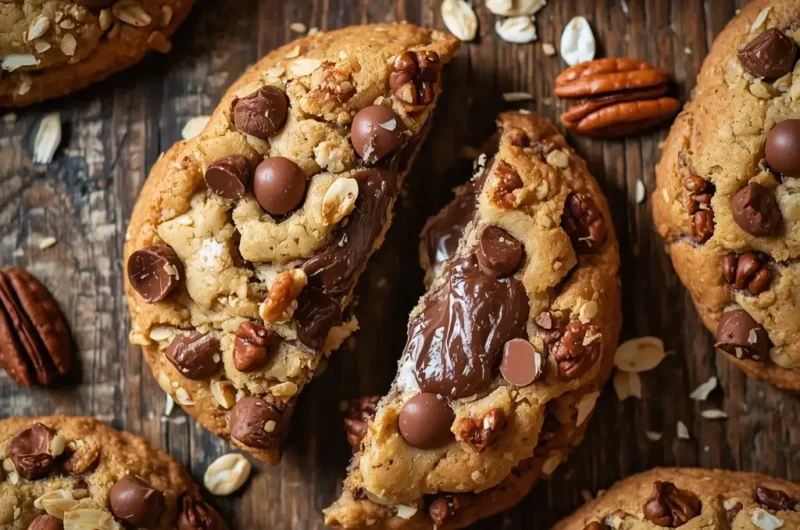
Best Cowboy Cookies Recipe – Chewy, Loaded & Texas-Sized
Course: CookiesCuisine: AmericanDifficulty: EasyPrep time
20
minutesCalories
300
kcalYield
14-16
Large CookiesBake Time
13
minChill Time
30
minTexture Rating
Crisp edge
Most cowboy cookie recipes fail you. They promise chewy, loaded, bakery-worthy results — and deliver thin, crispy discs that taste like trail mix pressed into a cookie cutter. After 14 years of professional pastry work — from hotel kitchens in Mumbai to artisan bakeries in London — I’ve reverse-engineered exactly where home bakers go wrong.
Ingredients
All-purpose flour 2 cups (240g)
Rolled oats (old-fashioned) 1½ cups (135g)
Unsalted butter 1 cup / 2 sticks (226g)
Brown sugar (dark) 1 cup (200g)
White granulated sugar ½ cup (100g)
Eggs 2 large
Egg yolk 1 extra
Pure vanilla extract 2 tsp
Baking soda 1 tsp
Baking powder ½ tsp
Fine sea salt 1 tsp
Cinnamon 1 tsp
Semi-sweet chocolate chips 1 cup (170g)
Chopped pecans ¾ cup (85g)
Sweetened shredded coconut ½ cup (43g)
Directions
- Step 1 : Toast Your Pecans First (10 min, 325°F / 163°C)
Spread pecans on a dry baking sheet. Toast until fragrant and one shade darker. This step takes 10 minutes and adds approximately 40% more flavour complexity. Let them cool before adding to dough or they’ll melt your chocolate chips prematurely.
Image prompt: Pecans spread on a parchment-lined baking sheet, lightly golden, steam rising slightly - Step 2 : Cream the Butter and Sugar (4–5 minutes)
Beat room-temperature butter with both sugars on medium-high speed for a full 4 to 5 minutes — not 2, not 3. You’re looking for a mixture that has gone from yellow and dense to pale, almost ivory, and noticeably fluffy. Run your finger across it; it should feel silky, not grainy.
This is your second-best tip: most home bakers under-cream. The air you incorporate here is your leavening insurance policy.
Image prompt: Stand mixer bowl showing pale, fluffy creamed butter and sugar, light and voluminous - Step 3 : Add Eggs One at a Time
Add the 2 whole eggs and 1 extra yolk one at a time, beating for 30 seconds after each. Add vanilla with the last egg. The batter should look glossy and emulsified — almost like a smooth custard base. If it looks curdled and broken, your eggs were too cold. - Step 4 : Combine Dry Ingredients and Fold
Whisk together flour, oats, baking soda, baking powder, salt, and cinnamon in a separate bowl. Add the dry mix to the butter base in two additions on low speed. Stop the moment no dry flour is visible — do not beat. Fold in chocolate chips, toasted pecans, and coconut by hand with a rubber spatula.
The dough should feel substantial. Dense, slightly tacky, and thick enough to hold a peak when you press your spatula into it. If it’s loose or sticky, your butter was too warm.
Image prompt: Rubber spatula folding chocolate chips and pecans into thick, golden cookie dough
Notes
- Room temperature: Airtight container, up to 5 days. Place a slice of bread in the container — it keeps cookies from drying out.
- Freezer (unbaked dough): Portion into balls, freeze on a sheet, then transfer to a bag. Bake from frozen at 350°F for 15–16 minutes.
- Freezer (baked): Up to 3 months. Reheat at 300°F for 5 minutes to restore chew.